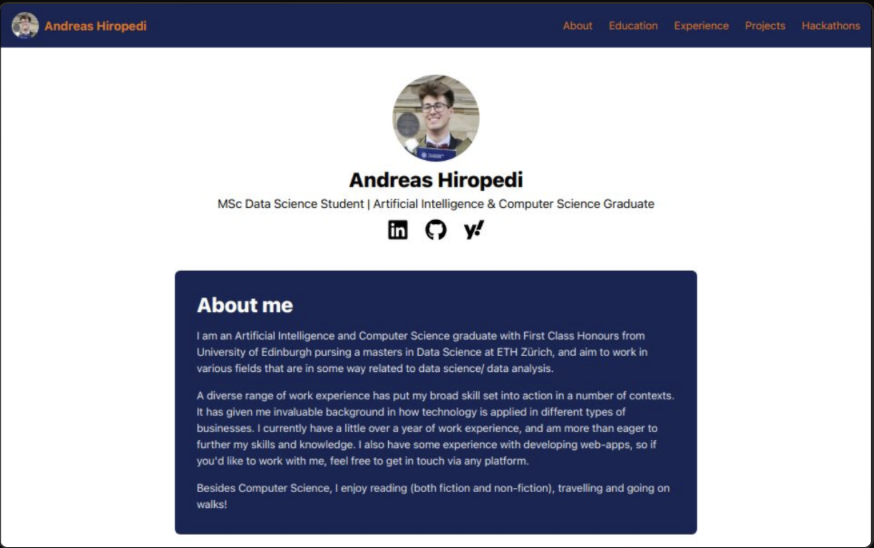
Andreas Hiropedi
MSc Data Science Student | Artificial Intelligence & Computer Science Graduate
About me
I am an Artificial Intelligence and Computer Science graduate with First Class Honours from University of Edinburgh pursing a masters in Data Science at ETH Zürich aiming to work in various fields that are in some way related to data science or data analysis. My research areas of interest are bioinformatics and biotechnology.
A diverse range of work experience has put my broad skill set into action in a number of contexts and has given me invaluable background in how technology is applied in different types of businesses. I currently have around three years of work experience and I am more than eager to further my skills and knowledge. Additionally, I have some experience with developing web-apps, so if you'd like to work with me, feel free to get in touch via any platform.
Besides coding, I enjoy reading (both fiction and non-fiction), trading, travelling, learning new languages and going on walks!
Education
ETH Zürich | MSc Data Science
Sep 2024 - Present
Grade: 5.25 (currently in progress)
Research experience: Bohacek Lab
Practical experience: Data Science Lab
Interdisciplinary area: Neural Information Processing (Introduction to Neuroinformatics, Systems Neuroscience)
Relevant courses: Big Data, Computational Statistics, Advanced Algorithms, Computational Semantics for Natural Language Processing, Statistical Modelling, High Dimensional Statistics, Applied Analysis of Variance and Experimental Design
The University of Edinburgh | BSc Artificial Intelligence and Computer Science
Sep 2020 - July 2024
Grade: First Class Honours (1:1)
Research experience: Biomolecular Control Group
Practical experience: Machine Learning Practical, Informatics Large Practical, System Design Project
Relevant courses: Foundations of Natural Language Processing, Foundations of Data Science, Introduction to Algorithms and Data Structures, BioInformatics 1, Operating Systems, Applied Cloud Computing
Fettes College
Aug 2015 - Jun 2020
IB Higher Level: Computer Science, Mathematics, Economics
IB Standard Level: Physics, English, Spanish
Experience
Rystad Energy | Technology Intern
Jun 2026 - Aug 2026; Oslo, Norway
- Worked as part of the Quality Assurance (QA) team
- More details to come!


nihito.io | Intern - Backend Development and Computational Load Balancing
Apr 2025 - May 2026; Zürich, Switzerland
- Designed and implemented API endpoints for multiple user flows of the nihito platform, including playing a key role in the launch of the MVP (minimum viable product)
- Provided clear documentation on several aspects of the platform including product requirements, API setup and cybersecurity analysis
- Worked on developing several prototypes and tools involving generative AI, including a newsletter summarizer, an AI agent for task management, a data explainer and a coding assistant prototype
- Worked on developing a side product involving route optimization and depot planning using GTFS public transport data from several travel agencies across Switzerland




BlackRock | Summer Analyst
Jun 2023 - Aug 2023; Edinburgh, UK
- Worked as part of the A.I. Labs team
- Generated scripts to compute and store several key performance metrics for the company’s in house machine learning models
- Set up automated pipelines to run the metric computation scripts at set interval times (e.g., weekly)
- Developed a web-app for displaying and monitoring these metrics over time


Vectare | Trainee Developer
Sep 2022 - May 2023; Loughborough, UK
- Worked as a part-time full-stack developer
- Worked on several aspects of Vectare’s website (vective), such as PrivateHire, Scheduling_Systems and Reports
- Improved the layout and design of their “Walkround Checks” page
- Worked extensively on developing the new “Driver sign on/ sign off” feature for both the website and Vectare’s driver app
- Helped produce some documentation used for external regulation checks
- Used Agile tools such as Scrum, Kanban boards, etc.


Graaphene | Summer Intern
Jun 2021 - Aug 2021; Chicago (IL), USA
- Contributed to the design of the company’s website, first using HTML and CSS, and then later using React
- Generated automated tests, as well as detailed documentation, for all components of the company’s website
- Performed manual testing for the company’s mobile app



Languages
- English (Native)
- Romanian (Native)
- Spanish (B2)
- German (B2)
- Italian (A2)
Publications
- Andreas Hiropedi, Yuxin Shen, Diego A. Oyarzún, ezSTEP: a no-code tool for sequence-to-expression prediction in synthetic biology, 2025 (in proceedings).
Projects
Below is a selection of the most notable projects I have worked on. Click here to see all projects
AI Agent for Managing To-Do Lists
March 2026
This web-app was developed as part of my internship at nihito, and this tool is currently available on the nihito platform (https://platform.nihito.io). The app allows the user to create a to-do list by simply typing in their tasks in natural language, and then uses a large language model to extract the key information from the user's input, such as the task description, the deadline for each task, and any other relevant details. The app then organizes the tasks into a structured format and displays them in a user-friendly interface, allowing the user to easily manage their to-do list and keep track of their tasks and deadlines.
AI Data Explainer
February 2026
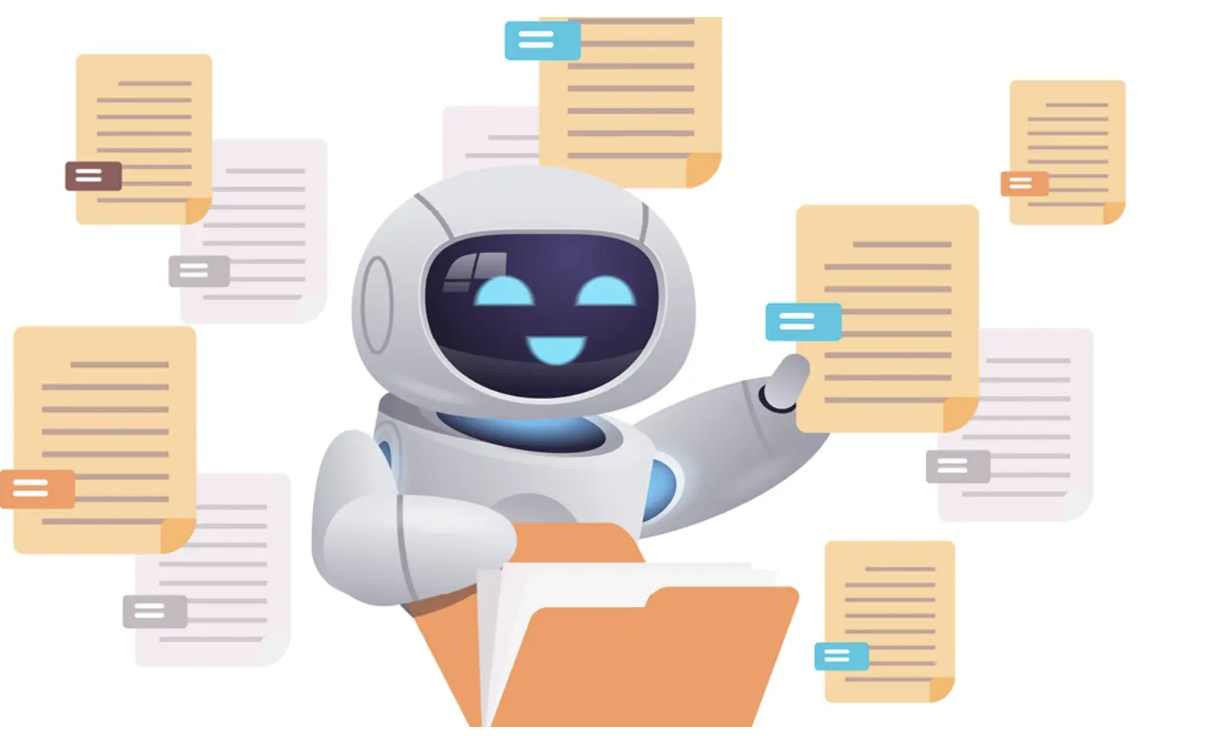
This web-app was developed as part of my internship at nihito, and this tool is currently available on the nihito platform (https://platform.nihito.io). The app allows the user to upload a dataset in csv format, and then uses a large language model to extract useful insights from the data, generate visualization plots, and also create a detailed report explaining the key features of the dataset, such as the distribution of values for each feature, the correlation between different features, etc.

Weather App
December 2025
This simple web-app was developed as part of my internship at nihito, and this tool is currently available on the nihito platform (https://platform.nihito.io). The app uses the OpenWeatherMap API and allows the user to first select any location around the world by typing it into a search bar and looking and the matches found (if any), and then look at a detailed breakdown as well as visualisations of the weather conditions at the selected location.

N2O Agriculture Emissions Predictor
September 2025 - December 2025
As part of the Data Science Lab course at ETH, together with my groupmate, we performed an in-depth analysis of N2O emissions at different agriculture sites throughout Switzerland, which included cropland, grassland or a mix of the two (cropland with a temporary period of grassland).
Once we finished our analysis, we augmented our datasets by computing additional predictors that are commonly used in literature, and we then conducted a series of experiments using several different machine learning algorithms (some of which we also applied hyperparameter optimisation to) and explored their ability to predict N2O emissions at each of these individual sites.



GenAI Newsletter Summarizer
Aug 2025
I developed this GenAI summarizer as part of my internship with nihito, and this tool is currently available on the nihito platform (https://platform.nihito.io). The project involved working on a tool that scans your mailbox for newsletter e mails (read or unread) from the past week, extracts all this information, feeds it into a large language model (LLM) using the OpenAI API in order to generate summaries for each of the found newsletters, and then sends an email response back to the user with all the generated summaries in a nice format.
This tool was designed as a web app that is linked to a SQLite database to allow for multi-user access and also for easy re-access and setting up automated pipelines to execute the fetch-summarize-return process at set intervals of time (weekly).


Portfolio Website
Sep 2024
The idea came to me once I realised that GitHub may not be the most creative way of showing off my skills and past projects, and therefore a more interactive option would be better. I developed this website using SvelteKit, and leveraged HTML and CSS for additional styling of components.

Flightradar24 Database
Aug 2024
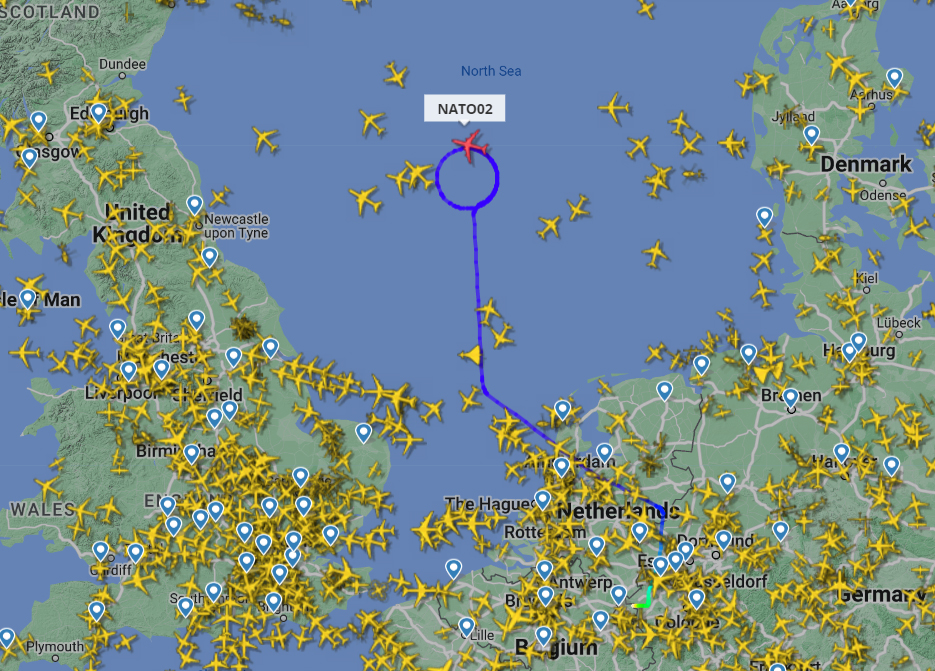
As part of the CS50 SQL course final project, I developed a mock database that aims to mimic the kind of data that a service like Flight Radar would store in order to display information about flights, albeit on a much smaller scale. The schema for the database, as well as the set of queries, were developed and tested using SQLite.

Honours Project
Sep 2023 - May 2024
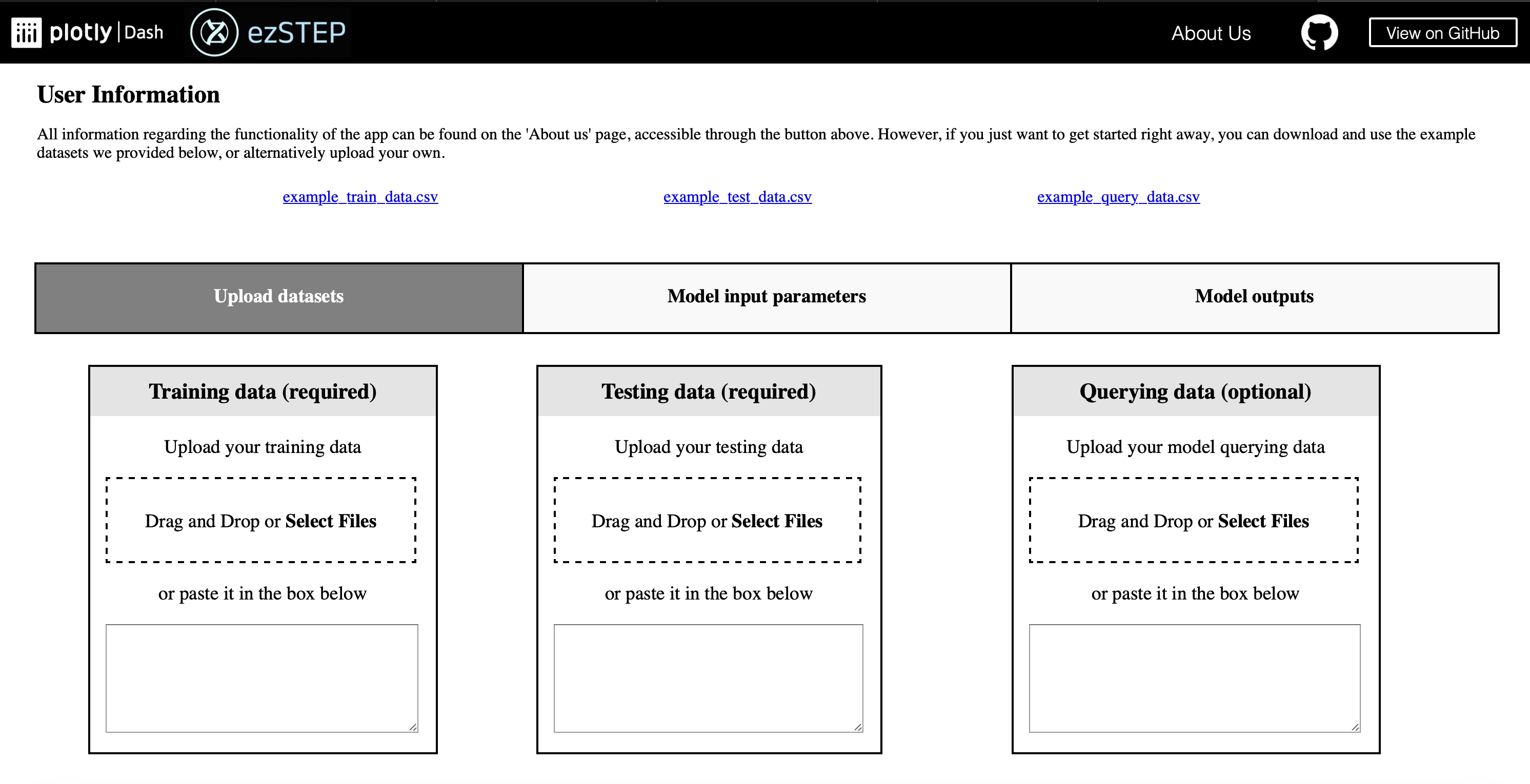
ezSTEP (Sequence-to-expression Predictor) is a machine-learning platform with a web-based user interface that enables the construction of automated machine-learning pipelines for computational analysis and predictions using regression.
This project was my undergraduate dissertation, for which I received a mark of 80% and it was recently made available on the university's archive for outstanding honours projects (see https://project-archive.inf.ed.ac.uk/ug4/20244194/ug4_proj.pdf). Additionally, together with my two supervisors and collaborators, Diego Oyarzun and his PhD student Yuxin Shen, we worked on a pre-print that, as of June 2025, has been accepted to the CIBB conference on Computational Intelligence methods for Bioinformatics and Biostatistics.


Hate Speech Detection
Jan 2024 - Apr 2024
As part of a group project for the Machine Learning Practical course at Edinburgh University, I worked with two other students on experimenting with several deep learning approaches for detecting implicit hate speech in tweets. Our approach used a three stage classification, first differentiating between hate/ no hate comments, then for hate comments differentiating explicit from implicit hate, and for implicit hate comments classifying them into several categories. Our hybrid approach, combining a transformer, namely BERT, with a convolutional neural network (CNN) showed very promising results on our chosen dataset (which we also augmented using back-translation).




Scottish NHS Analysis
Mar 2022 - May 2022
An in-depth analysis of the performance of the NHS A&E services before, during, and after the Covid-19 pandemic. This was a group project on which I worked with two other students, and together we performed several statistical analysis such as K-means clustering and generated multiple visualisations to answer a series of questions.

Connect-X
Jan 2021 - Mar 2021
An altered version of the game of Connect-Four, developed using Java. The users can select the dimensions of the board as well as the number of dots connected that is needed to win, and they can either choose the multi-player mode (playing against another human) or to the single player mode, where they can choose the difficulty of the AI they are playing against.

Cryptocurrency Predictor
May 2020 - Aug 2020
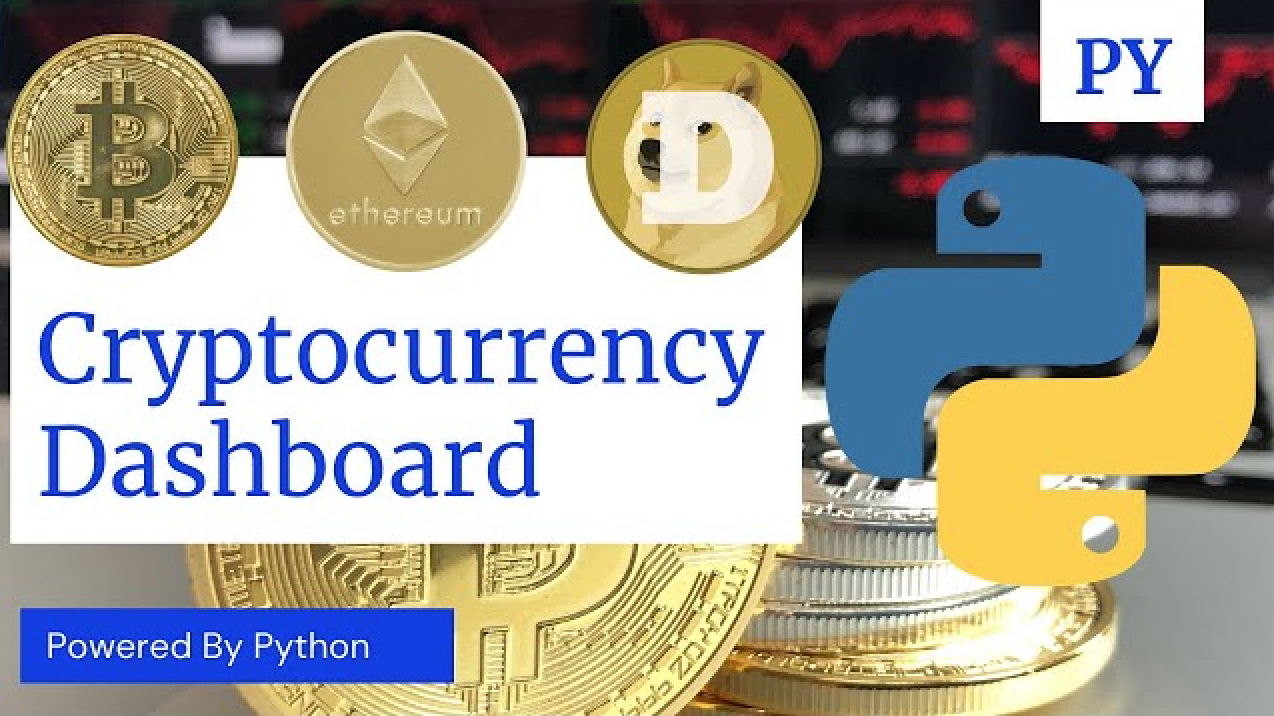
As a continuation of my IB project which I started developing in high school, I created a web dashboard (using Python and Streamlit) to display graphs and values of cryptocurrency predictions for Bitcoin, Ethereal and Dogecoin. The user gets to select the date in the future up until which the predictions should be generated, and the dashboard then uses all past data (from Yahoo finance) to generate predictions up until the inputted date.
Hackathons
AdaHack 23
Feb 2024
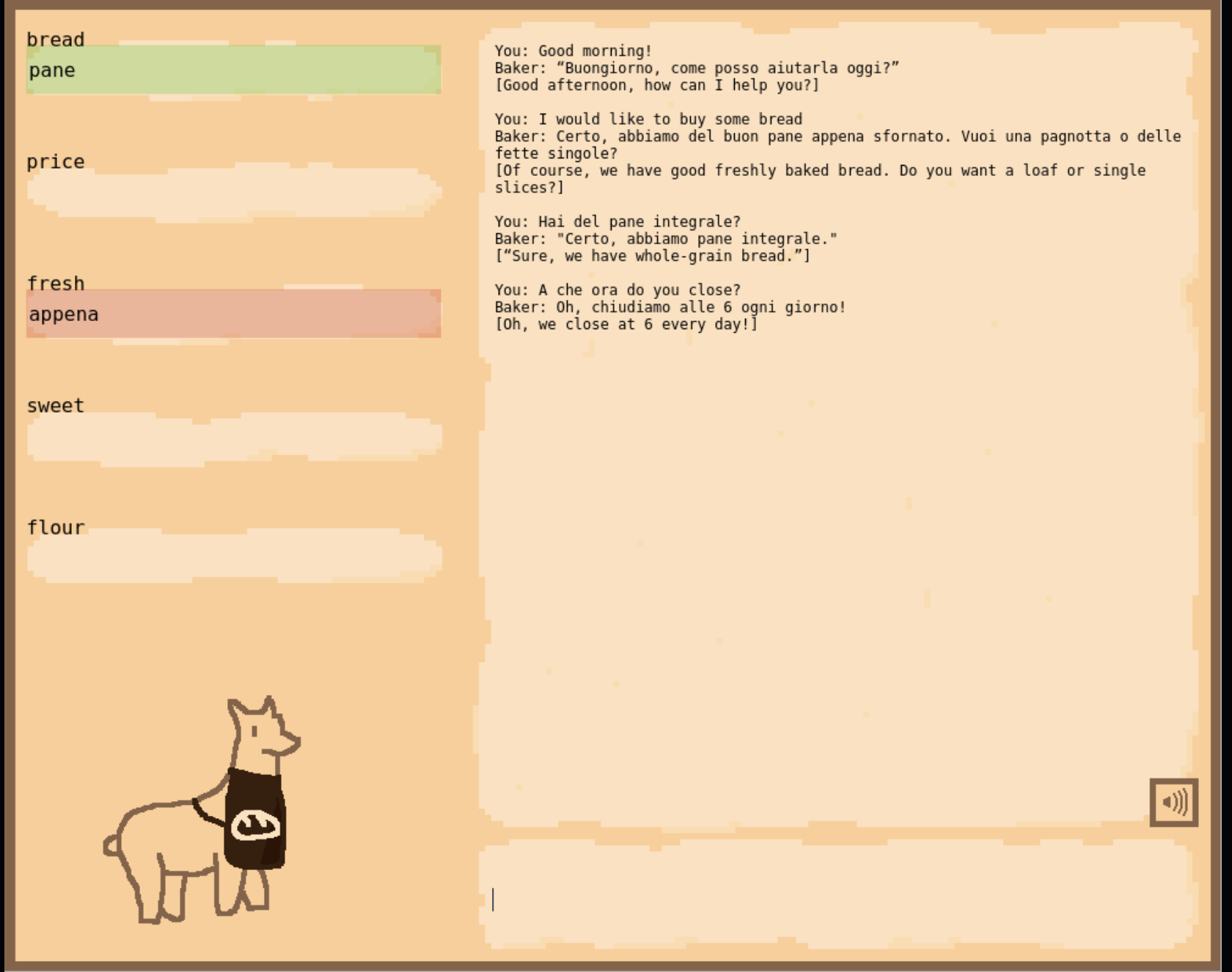
As a team of four in the Adahack 23 hackathon, we tackled the following challenge: Design a mini-game that uses an open AI chatbot to teach players basic phrases or vocabulary through interactive dialogue.
The app allows you to have a bilingual conversation in a setting of your choice. The goal is to ask the right questions to identify five basic vocabulary words.
Input is supported in both English and a second language of choice, and the app can even handle language mixing within a sentence! A locally installed LLAMA2 LLM generates replies, which are printed in both languages, as well as played out loud using Google's text-to-speech models. The last reply can also be replayed by pressing the speaker button.